Study note: This article is provided for traditional culture study and theoretical research only. Zi Wei Dou Shu is presented here as part of the Chinese cultural knowledge system of destiny studies. It does not constitute personal, medical, financial, legal, or decision-making advice.
A Visual Starting Point
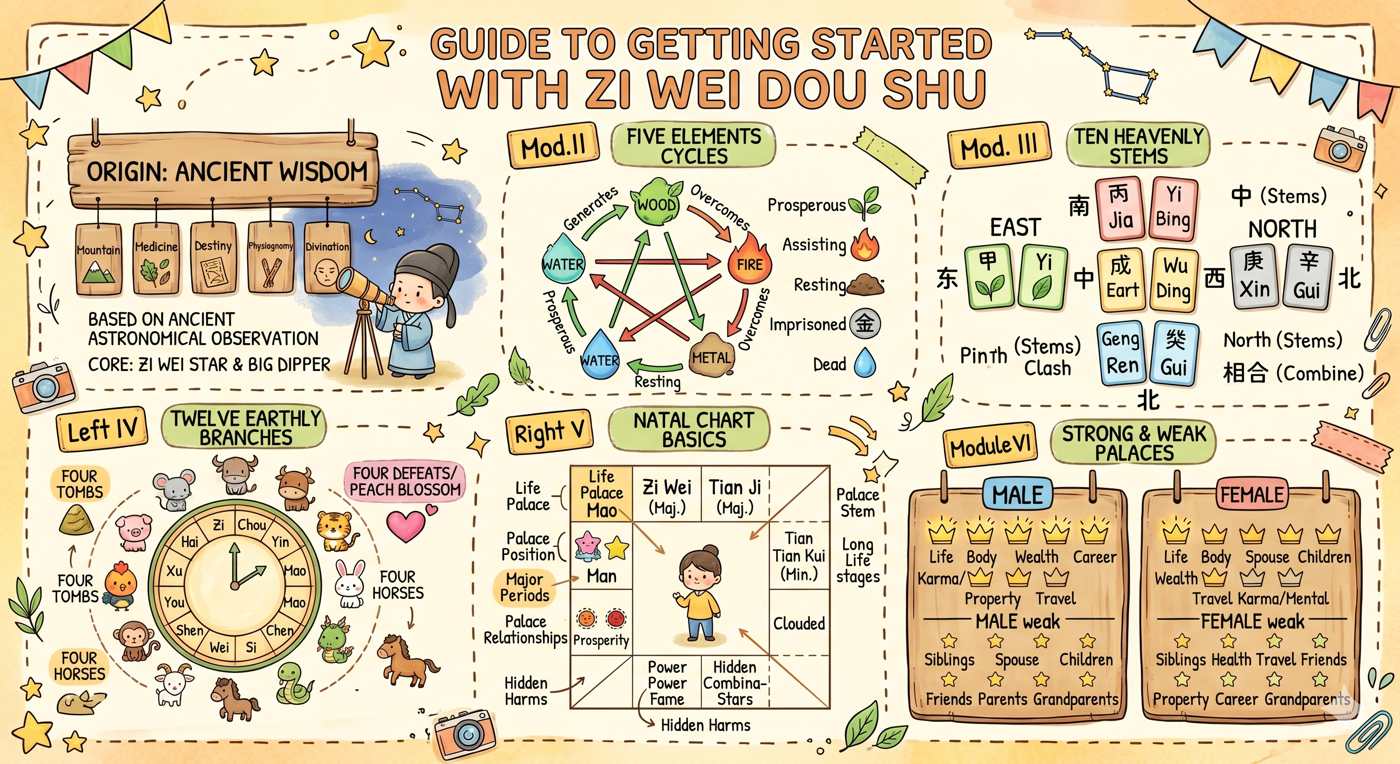
Illustrated overview of Zi Wei Dou Shu foundations, including origins, Five Elements cycles, Heavenly Stems, Earthly Branches, natal chart basics, and strong versus weak palaces.
1. Where Zi Wei Dou Shu Comes From
Zi Wei Dou Shu belongs to the broader classical Chinese tradition often summarized as Mountain, Medicine, Destiny, Physiognomy, and Divination. Within that larger tradition, Zi Wei Dou Shu developed as a destiny-analysis system rooted in ancient astronomy.
Its symbolic world is built from observation of the sky, especially the importance of the Zi Wei star region, the North Star, the Big Dipper, and related constellations. In other words, the system is not merely a random set of fortune-telling labels. It is a structured symbolic model derived from the old Chinese way of linking heaven, time, and human life.
For beginners, this point matters. Zi Wei Dou Shu should first be understood as a branch of traditional cultural knowledge and cosmological thinking, not as a simplistic prediction machine.
2. The Role of the Five Elements
Like many other branches of Chinese metaphysics, Zi Wei Dou Shu relies on the Five Elements:
Wood, Fire, Earth, Metal, Water
These five are not physical substances alone. They are categories of movement, tendency, and relationship. Their two most important interactions are:
- Generating cycle: Wood → Fire → Earth → Metal → Water → Wood
- Overcoming cycle: Wood controls Earth, Earth controls Water, Water controls Fire, Fire controls Metal, Metal controls Wood
The classical learning sequence also places strong emphasis on the changing strength of the Five Elements by season. A commonly used framework is:
- Prosperous (Wang): the element currently in season
- Assisting (Xiang): the element generated by the seasonal element
- Resting (Xiu): the element that generates the seasonal element
- Imprisoned (Qiu): the element that overcomes the seasonal element
- Dead (Si): the element overcome by the seasonal element
This seasonal logic helps students understand why the same element may be strong in one context and weak in another.
3. The Ten Heavenly Stems
The Ten Heavenly Stems are one of the core building blocks used throughout Chinese metaphysics:
Jia, Yi, Bing, Ding, Wu, Ji, Geng, Xin, Ren, Gui
The study notes emphasize their directional and elemental allocation:
- East / Wood: Jia, Yi
- South / Fire: Bing, Ding
- Center / Earth: Wu, Ji
- West / Metal: Geng, Xin
- North / Water: Ren, Gui
In addition to direction and element, students also learn that stems can form clashes and combinations. These relationships matter because they show how symbolic forces interact rather than standing alone as isolated labels.
4. The Twelve Earthly Branches
The Twelve Earthly Branches are:
Zi, Chou, Yin, Mao, Chen, Si, Wu, Wei, Shen, You, Xu, Hai
In beginner study, they are often arranged around a circular diagram, similar to a clock face, so that the learner can intuit their sequence, seasonal movement, and directional logic.
Several classical groupings are especially important:
Four Tombs or Four Storage Branches
Chen, Xu, Chou, Wei
These are associated with Earth and with the idea of storage, accumulation, or enclosure.
Four Defeats or Peach Blossom Branches
Zi, Wu, Mao, You
These branches often carry strong symbolic meaning in social, emotional, and expressive readings.
Four Horses or Four Birth Places
Yin, Shen, Si, Hai
These are associated with movement, transition, travel, activation, and dynamic change.
Understanding these branch groupings gives beginners a practical memory framework before they attempt more advanced chart interpretation.
5. Understanding the Natal Chart
A Zi Wei Dou Shu natal chart is organized into twelve palaces, each representing a key area of life. Standard palace names include:
- Life
- Siblings
- Spouse
- Children
- Wealth
- Health
- Travel
- Friends
- Career
- Property
- Karma or Mental
- Parents
These palaces do not function as isolated boxes. They also relate to one another through structural relationships such as hidden combinations and hidden harms.
In practical chart reading software, each palace cell usually contains multiple layers of information at once, including:
- the palace name
- the Earthly Branch of that palace
- major stars
- supporting stars
- Four Transformations such as Lu, Quan, Ke, Ji
- groups of auxiliary symbolic stars
- the Twelve Life Stages
- major decade luck periods and annual periods
Beginners often feel overwhelmed because a single palace appears to contain too much information. The right approach is to recognize the layout first, then learn each layer one at a time.
6. Direction, Yin-Yang, and Period Movement
The notes also explain that chart direction and major period movement depend on Yin-Yang polarity together with the Heavenly Stem of the birth year.
A simplified traditional rule is:
- Yang male / Yin female: major periods move forward
- Yin male / Yang female: major periods move backward
This directional logic is part of how the chart becomes dynamic rather than remaining a static birth diagram.
Another important concept is the Body Palace (Shen Gong). While the Life Palace is central, the Body Palace acts as a key secondary palace and often reveals how a person physically engages with their life path.
7. Strong and Weak Palaces
The document distinguishes between palaces with stronger life impact and those with relatively weaker impact. The grouping differs by gender in the traditional framework.
Stronger palaces for men
Life, Body, Wealth, Career, Karma/Mental, Property, Travel
Weaker palaces for men
Siblings, Spouse, Children, Health, Friends, Parents
Stronger palaces for women
Life, Body, Spouse, Children, Wealth, Property, Karma/Mental
Weaker palaces for women
Siblings, Health, Travel, Friends, Career, Parents
This does not mean the weaker palaces are unimportant. It means that in the traditional teaching sequence, some palaces are treated as having broader life influence and therefore receive special attention in interpretation.
8. A Good Beginner Learning Path
For a beginner, Zi Wei Dou Shu becomes much easier if studied in the following order:
- Learn the Five Elements and their generating and overcoming cycles.
- Memorize the Ten Heavenly Stems and Twelve Earthly Branches.
- Understand the twelve palace names and what life areas they represent.
- Learn the Four Transformations and the idea of major and annual periods.
- Practice identifying chart structure before trying to interpret every star.
The key is not speed but layering. Zi Wei Dou Shu is a dense symbolic language. Students who learn the chart structure first usually progress more smoothly than those who try to memorize star meanings without understanding the framework.
9. Frequently Asked Questions
What is the relationship between Zi Wei Dou Shu and ancient astronomy?
Zi Wei Dou Shu is deeply connected to traditional Chinese astronomy. Its symbolic logic draws from ancient observation of the North Star, the Big Dipper, and celestial regions used to model time and human affairs.
Why are the Five Elements important in Zi Wei Dou Shu?
Because the Five Elements provide the relational grammar of the system. They explain support, conflict, timing, and changing strength, which are all essential for chart interpretation.
Why do beginners struggle with the natal chart?
Because each palace combines many kinds of information at once. The solution is to learn the chart layout first and then add layers of interpretation step by step.
Does this system provide guaranteed predictions?
From the perspective of traditional culture study, Zi Wei Dou Shu is a symbolic and interpretive framework rather than a guaranteed prediction engine. This article presents it for educational and cultural research only.
10. Summary
Zi Wei Dou Shu begins with a cultural and astronomical worldview. Its foundations include the Five Elements, the Heavenly Stems, the Earthly Branches, and the twelve-palace natal chart. Once these foundations are clear, later study of stars, transformations, and timing methods becomes much more manageable.
For the beginner, the first goal is simple: understand the structure before chasing advanced interpretation.
Related Reading: Introduction to Zi Ping Ba Zi: From Four Pillars Basics to Pattern Analysis | Articles Index
Disclaimer: This article is based on traditional Chinese cultural knowledge systems and is written for educational and cultural research purposes only. It does not constitute financial, medical, legal, or life-decision advice of any kind.