Study note: This article is adapted from course materials and is provided for traditional culture study and theoretical research. On this site, Qi Men Dun Jia is introduced only as a Chinese cultural and symbolic timing model. It does not constitute decision-making, professional, financial, medical, legal, or personal advice.
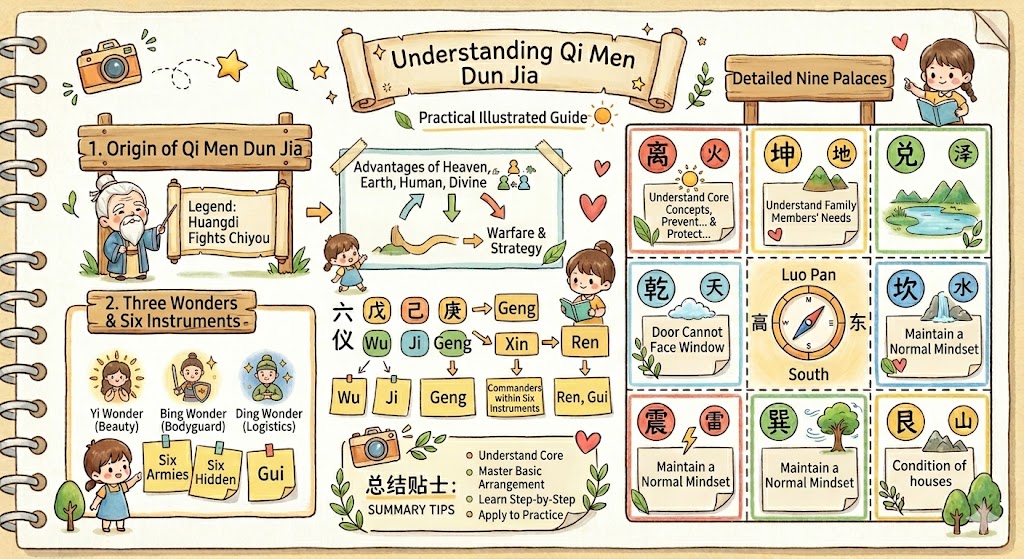
Illustrated overview of the legendary origins of Qi Men Dun Jia, the Three Wonders and Six Instruments, and the Nine Palace layout.
1. Origins and Historical Background of Qi Men Dun Jia
The Siku Quanshu once described Qi Men Dun Jia as “the most logically refined among the technical arts.” This statement suggests that, within the traditional Chinese technical arts, Qi Men Dun Jia was regarded as a highly structured, methodical, and theoretically sophisticated system.
A well-known legend connects its origin to the ancient war between Chi You and the Yellow Emperor. According to the story, the Yellow Emperor was once trapped in a difficult military situation. The Nine Heavens Mysterious Lady then transmitted the art of Qi Men Dun Jia to him, enabling him to arrange troops, choose timing and direction, and turn the tide of battle.
Although this story is mythological, it reflects an important cultural point: Qi Men Dun Jia has long been associated with military strategy, spatial timing, troop deployment, and strategic judgment.
From a learning perspective, Qi Men Dun Jia can be broadly divided into two streams:
- Mathematical Qi Men: A symbolic and structural system based on Heavenly Stems, Earthly Branches, Nine Palaces, Eight Gates, Nine Stars, Eight Spirits, and chart calculation.
- Ritual or magical Qi Men: A stream involving talismans, rituals, incantations, and magical procedures.
The focus here is the more structured and systematic form: Mathematical Qi Men.
2. What the Four Characters “Qi Men Dun Jia” Mean
To understand Qi Men Dun Jia, one must first understand Jia.
In Qi Men Dun Jia, Jia represents the supreme commander, the central authority, or the highest-level leader. Because Jia is the most important commander, it must be protected and cannot be exposed carelessly.
Therefore, Dun Jia means “to hide Jia.” Here, dun does not mean disappearance. It means concealment, protection, and strategic withdrawal from direct danger. Jia does not appear directly; instead, it is hidden within the Six Instruments and expressed through other symbols and structures.
The “Qi” in Qi Men refers especially to the Three Wonders, which support and protect Jia:
| Three Wonder | Traditional image | Role analogy |
|---|---|---|
| Yi Wonder | Beauty Wonder | Chief strategist; leader of civil officials |
| Bing Wonder | Son Wonder | Chief guard; leader of military officers |
| Ding Wonder | Daughter Wonder | Chief logistics officer |
In addition, the Eight Gates represent human affairs. They describe actions, opportunities, obstacles, and practical states in specific situations.
Historically, Qi Men Dun Jia may be understood as a traditional knowledge system used for troop arrangement, strategic timing, spatial positioning, and the judgment of battlefield conditions.
3. Main Types of Qi Men Dun Jia
Qi Men Dun Jia can be classified in several ways.
1. By time scale
According to the time scale used to cast a chart, Qi Men can be divided into:
| Type | Basis | Practical meaning |
|---|---|---|
| Year Qi Men | Year-based chart | Used for annual trends; the largest time scale |
| Month Qi Men | Month-based chart | Used for monthly trends |
| Day Qi Men | Day-based chart | Used for daily trends |
| Hour Qi Men | Two-hour-period chart | Highest resolution; used for detailed affairs |
This course mainly uses Hour Qi Men because it has a finer resolution and is more suitable for analyzing specific matters.
2. By charting method
According to the charting method, Qi Men can also be divided into:
| Method | Characteristics |
|---|---|
| Rotating Plate Qi Men | The Three Wonders, Six Instruments, and related parameters rotate through the palaces; this is a common public method |
| Flying Plate Qi Men | Parameters fly numerically into the palaces according to a sequence |
This course uses Rotating Plate Qi Men.
4. Core Parameters: The Three Wonders and Six Instruments
One of the central parameter groups in Qi Men Dun Jia is the Three Wonders and Six Instruments.
1. The Three Wonders: forces that protect Jia
The Three Wonders are Yi, Bing, and Ding. Their function is to protect the supreme commander Jia.
Yi Wonder
In traditional interpretation, Geng Metal controls Jia Wood. To protect Jia Wood, Yi Wood, as the “younger sister,” joins with Geng Metal. Once Geng becomes the “brother-in-law,” it no longer harms Jia. This symbolic story shows Yi’s role in mediation, coordination, counsel, and conflict resolution.
Yi Wonder may therefore represent:
- Civil officials
- Strategic advisers
- Flexible coordinating forces
- Pressure reduction through relationship and strategy
Bing Wonder
Jia Wood gives birth to Bing Fire, so Bing Fire is like Jia’s son. Fire controls Metal, so Bing can help Jia resist the pressure of Geng Metal. Bing symbolizes visibility, brightness, action, and defense.
Bing Wonder may therefore represent:
- Military officers
- Guards and protective forces
- External defense
- Active protection and initiative
Ding Wonder
Ding Fire is also born from Jia Wood and can also control Geng Metal. Compared with Bing Fire, Ding Fire is more subtle, refined, and hidden. It is often associated with logistics, details, resource coordination, and quiet support.
Ding Wonder may therefore represent:
- Logistics
- Resource support
- Detailed execution
- Hidden assistance
2. The Six Instruments: six armies
The Six Instruments are:
Wu, Ji, Geng, Xin, Ren, Gui
They represent six armies. The so-called Six Jia are the commanders of these armies.
The chief commander is Jia Zi Wu, who governs the Wu army. The other five are deputy commanders and are also called Jia. These six commanders are hidden within the Six Instruments. This is the structural meaning of Dun Jia.
In other words, Jia does not appear directly. It is hidden in the Six Instruments and expresses its position and function through them.
5. The Concept of Emptiness
Another important concept in Qi Men Dun Jia is emptiness.
There are ten Heavenly Stems and twelve Earthly Branches. When the stems and branches are paired, two branches remain unpaired after the ten stems are used. These two branches are called empty.
Basic meanings of emptiness include:
- A matter has not yet materialized
- Information is incomplete
- The state is unstable
- Something exists in name but lacks substance
- A result is temporarily unavailable
In practice, emptiness does not simply mean “bad.” It indicates that a palace, symbol, or matter may be unformed, unsettled, or not yet in place. It must be judged together with the whole chart.
6. Chart Formation and the Order of the Three Wonders and Six Instruments
The Three Wonders and Six Instruments form the Tai Ji array of Qi Men. Their fixed order is:
Wu, Ji, Geng, Xin, Ren, Gui, Ding, Bing, Yi
This sequence is essential for chart calculation.
Qi Men Dun Jia is also divided into Yang Dun and Yin Dun:
| Type | Arrangement | Number of Ju |
|---|---|---|
| Yang Dun | Forward sequence | 9 Ju |
| Yin Dun | Reverse sequence | 9 Ju |
The Ju number is determined by the twenty-four solar terms:
- From Winter Solstice to Summer Solstice: Yang qi gradually increases, so Yang Dun is used.
- From Summer Solstice to Winter Solstice: Yin qi gradually increases, so Yin Dun is used.
Qi Men Dun Jia is therefore not an isolated symbolic game. It is built upon solar terms, yin-yang cycles, and time rhythms.
7. The Nine Palaces
Qi Men Dun Jia uses the Later Heaven Bagua Nine Palace structure. It may be understood as an angular, structured version of a yin-yang Tai Ji diagram.
The Nine Palaces include eight directional palaces and one central palace:
Xun 4    Li 9     Kun 2
Zhen 3   Center 5 Dui 7
Gen 8    Kan 1    Qian 6
The Center 5 palace is the Tai Ji point. The other eight palaces revolve around it and carry movement, rotation, and transformation.
From a yin-yang perspective:
- The left-side palaces—Kan, Gen, Zhen, and Xun—may be understood as the Yang region, where yang qi gradually increases.
- The right-side palaces—Li, Kun, Dui, and Qian—may be understood as the Yin region, where yin qi gradually increases.
The Nine Palaces are not only spatial directions. They are also the foundational structure that carries the Heavenly Stems, Eight Gates, Nine Stars, Eight Spirits, and other parameters. In later study, all symbols must finally be placed into the Nine Palaces for integrated judgment.
8. Summary
This lesson establishes the basic framework of Qi Men Dun Jia:
- Qi Men Dun Jia is rooted in traditional military strategy and spatial timing. Legend says it was transmitted by the Nine Heavens Mysterious Lady to the Yellow Emperor.
- The focus here is Mathematical Qi Men rather than ritual or magical Qi Men.
- Jia represents the supreme commander; Dun Jia means hiding and protecting Jia.
- Yi, Bing, and Ding symbolize strategic, defensive, and logistical support.
- Wu, Ji, Geng, Xin, Ren, and Gui are the Six Instruments, representing six armies in which the Six Jia are hidden.
- Emptiness indicates that a matter is not yet settled, formed, or fully substantial.
- The fixed order of the Three Wonders and Six Instruments is: Wu, Ji, Geng, Xin, Ren, Gui, Ding, Bing, Yi.
- The Nine Palaces, with Center 5 as the Tai Ji point, form the spatial foundation for all later analysis.
After mastering these basics, one can continue to study the Eight Gates, Nine Stars, Eight Spirits, Heaven Plate, Earth Plate, Human Plate, and Spirit Plate as a more complete Qi Men Dun Jia system.